Registriere Dich oder melde Dich im MyMountainClub an, um Deine Meinung zu diesem Thema abzugeben.
zum Login/RegistrierungThe following figures and surveys on winter temperature and snow measurement series from Kleinwalsertal, Arlberg, and Bregenzerwald come from Tyrolean ski tourism researcher Günther Aigner in collaboration with "Zukunft-Skisport."
All data comes from official institutes – the Austrian Central Institute for Meteorology and Geodynamics (ZAMG), MeteoSwiss, and the Hydrographic Service of the State of Vorarlberg.
Decline in winter temperatures
Winters on the Arlberg ski mountain Galzig (2,090 m) have become colder over the past 30 years (1987/88 to 2016/17). The temperature has been falling in a linear trend from minus 4.0 to minus 5.4 degrees Celsius, a decrease of 1.4 degrees.
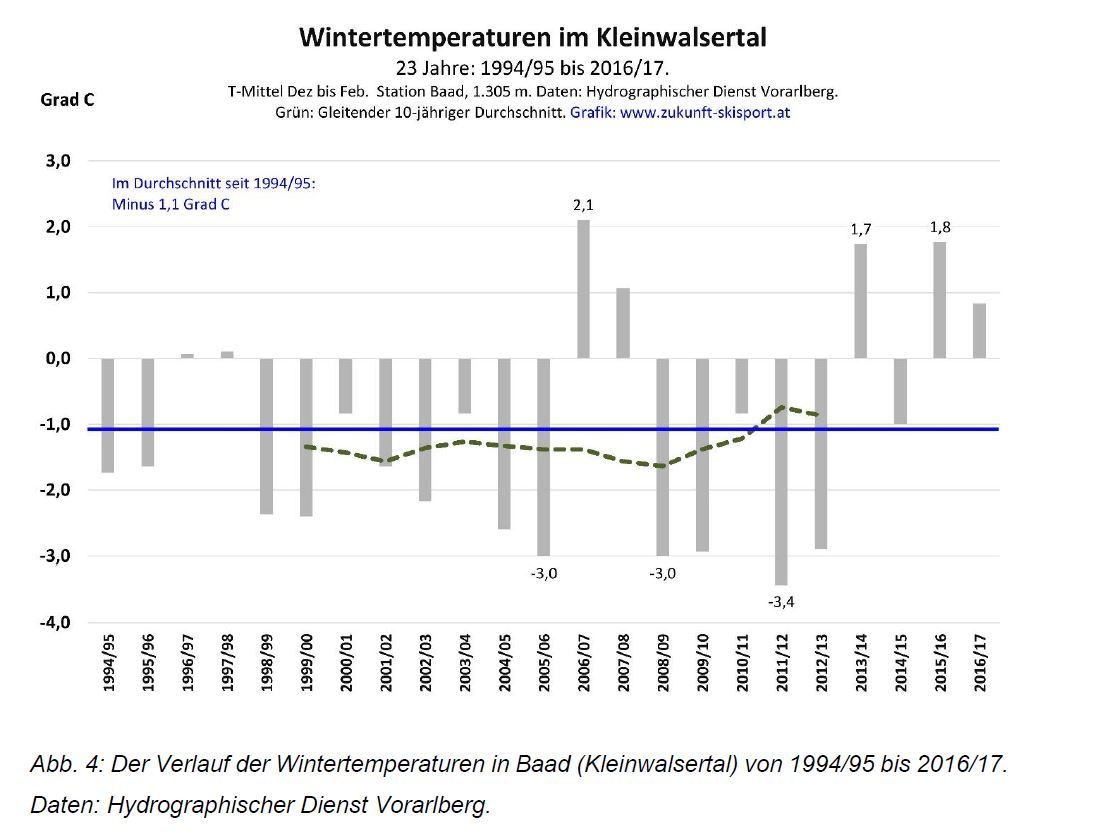
The Hydrographic Service of the State of Vorarlberg has been recording air temperatures in Baad in the Kleinwalsertal since 1994. The measurements are taken at an altitude of 1,305 meters and are typical for the valleys of the Kleinwalsertal, while the "Galzig" measurement series can be considered representative of the high elevations of the Kleinwalsertal.
From 1994/95 to 2016/17 (23 years), the average winter temperature was minus 1.1 degrees Celsius. The warmest winter was observed in 2006/07 with plus 2.1 degrees Celsius, while the winter of 2011/12 was the coldest in the series, with an average of minus 3.4 degrees Celsius. The 10-year average (green line) smooths out the picture of the series, which is characterized by high variability in winter temperatures.
Development of snow amounts
The Hydrographic Service of the State of Vorarlberg and the ZAMG possess excellent data for analyzing snow depths in Kleinwalsertal and its immediate surroundings. The measurement series in Schröcken dates back to the winter of 1900/01.
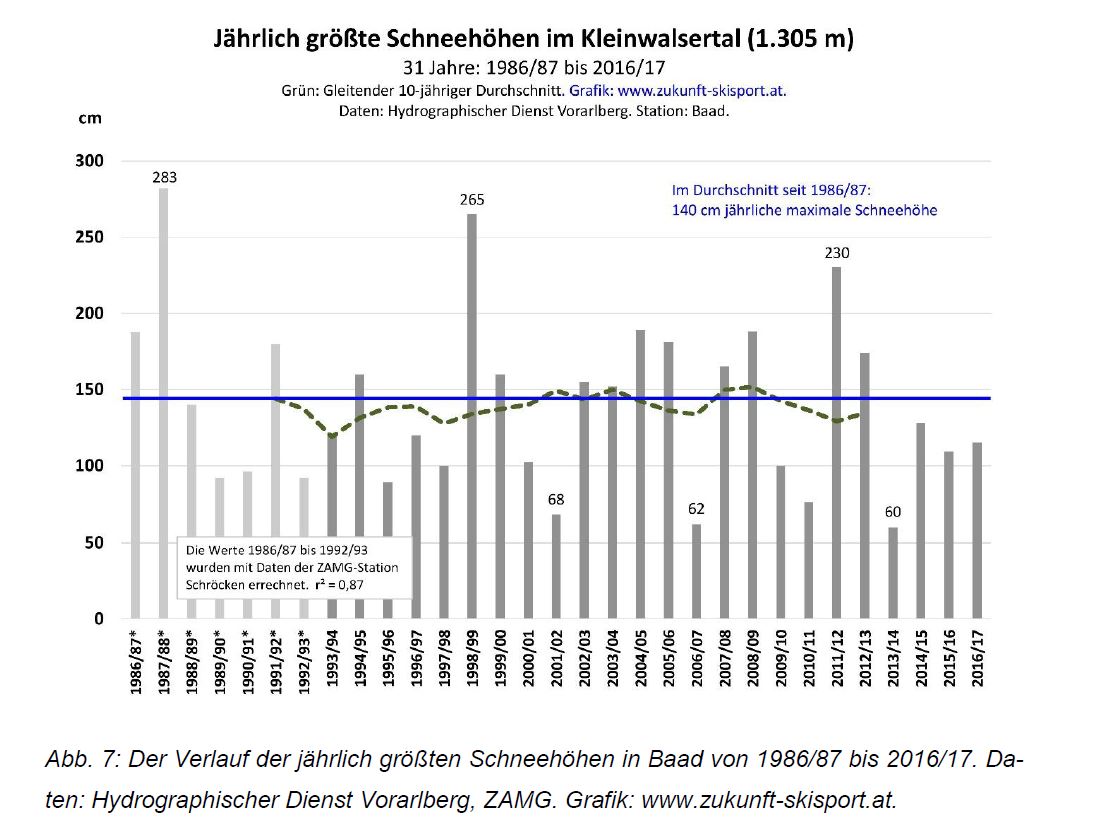
The snow data in Baad are collected by the Hydrographic Service of the State of Vorarlberg. The data series began in the winter of 1993/94. The values from 1986/87 to 1992/93 were calculated with the help of the neighboring ZAMG station in Schröcken in the Bregenzerwald. The measurement field is located at an altitude of 1,305 meters.
The figure shows the annual maximum snow depth in Baad from 1986/87 to 2016/17. The average is 140 centimeters. The extreme values in the measurement series are in 1987/88 with 283 centimeters (calculated value), 1998/99 with 265 centimeters (measured value) and 2013/14 with only 60 centimeters of snow depth.
Status Quo: Skiing in Kleinwalsertal
A short series of temperature measurements taken by the Vorarlberg Hydrographic Service in Baad (1,305 meters) suggests a trend toward slightly warmer winters in the valleys of the Kleinwalsertal Valley over the past 23 years.
An analysis of the snow measurement series in Kleinwalsertal (Baad station) has not provided any statistical evidence of a decrease in the annual maximum snow depths or the total amount of new snow over the past 30 years. The annual number of days with snow cover is declining slightly.
Based on the official measurement data evaluated in this study, an end to winter sports in Kleinwalsertal cannot be deduced from the current data. Nevertheless, it should be noted that measurement data always describe the past: no predictions for the future can be made from the statistical analyses presented in this study.
Climate change & ski tourism - Statement from the Association of German Cable Cars