On the Austrian side, the Heuberg, Ifen, and Walmendingerhorn cable cars will open on May 19th. The season begins on May 21st on the Austrian side for the Zaferna and Kanzelwand cable cars, and on the German side for the Söllereck cable cars. The Nebelhorn and Fellhorn cable cars will open on May 22nd. Mountain restaurants will also open at the same time. "With our offerings, we fulfill the longing for a bit of normality, fresh air, and the unique nature of this two-country region. And everyone can do so with a clear conscience," explains Andreas Gapp, CEO of OBERSTDORF · KLEINWALSERTAL BERGBAHNEN.
The proven hygiene concept from last summer has been adapted to the new requirements. "We are ensuring the important framework so that everyone can regain their freedom on the mountain," says Henrik Volpert, also CEO of OBERSTDORF · KLEINWALSERTAL BERGBAHNEN. It is important for the mountain railways to be able to offer wonderful nature experiences. "But these must be possible for customers safely, securely, and responsibly," Volpert continues.
Study proves: Good air exchange in gondolas
The new concept is based on the well-known hygiene concept tested in summer 2020. As a general rule, mountain railway customers must wear an FFP2 mask in the gondolas and in enclosed spaces. A minimum distance of two meters from people who do not come from the same household is also always guaranteed. Markings have been placed for this purpose, including outside the valley station. Currently, the requirements for the Austrian and German sides are different. In Austria, FFP2 masks are mandatory in the gondola, and only half the seats are allowed per cabin. Generally, you do not need to be tested, vaccinated, or recovered to take a ride up the mountain. On the German side, however, you must provide proof of a negative test, full vaccination, or recovery. The hygiene requirements for visiting mountain restaurants are the same on both sides of the border. Here, guests must first register and also be vaccinated, recovered, or tested. Then nothing stands in the way of enjoyment for body and soul. Swiss researchers have found in a recent study that a gondola ride poses no risk. In well-ventilated cabins, there is a very high air exchange. The risk of becoming infected during a 12-minute gondola ride is about 100 times lower than during an eight-hour workday in a poorly ventilated office. Compared to a dinner with eight people in 30 square meters, the risk of infection is even 1,000 times lower.
Still a lot of old snow at the mountain stations
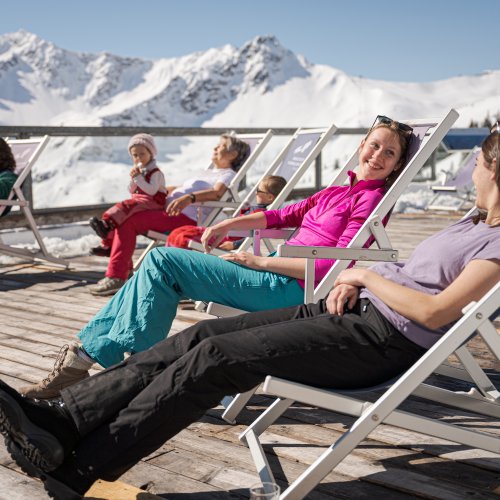
Due to the heavy snowfall at the end of winter, there is still a lot of snow at the mountain stations. Nevertheless, there is already a lot to discover up there. Whether on the sun terraces, with their loungers inviting you to relax and unwind, or in the open mountain restaurants with their regional delicacies. But there is also something for active people. The first paths have already been cleared of snow, inviting hikers to hike down to the valley or, for example, to the Riezler Alpsee lake at the Kanzelwand. With the appropriate equipment, of course! "To avoid overcrowding due to the current snow-related limited space on the mountain, we will, if necessary, regulate the number of guests in the valley," says Andreas Gapp. He continues: "This will allow every guest to experience their very own feel-good moment on the mountain."
New parking concept goes online, reducing traffic searching for parking spaces
The test phase for the parking space counting systems at selected parking lots in Oberstdorf and Kleinwalsertal has been running for a year. Based on the insights gained and the development of a guest-friendly digital display, the new landing page www.parken-ok.com has now gone online in collaboration with the Oberstdorf and Kleinwalsertal destinations. This allows guests to find out about the current parking situation on site and which parking lots currently have free space, even before or during their arrival. "We are pleased to be contributing a first significant step towards visitor management with this concept. With the new system, we can already display the available capacity at the first parking spaces with pinpoint accuracy, and at the other parking spaces, whether the space is free or occupied. The number of pinpoint parking spaces will be expanded gradually," says Johannes Krieg, board colleague of Andreas Gapp and Henrik Volpert. The new website also offers various filter options for parking spaces, and the inclusion of geodata makes entering information into the vehicle navigation system much easier.